football-trackers¶
Personal, open DIY system for real-time tracking of youth football players. Each player wears a small ESP32 + GNSS device that streams position at 10 Hz over WiFi to a local broker; a Bun + Elysia service ingests, server-stamps, and fans out to a live coach view. A personal hobby project — fully self-contained, built end to end (hardware, firmware, backend, frontend, CV).



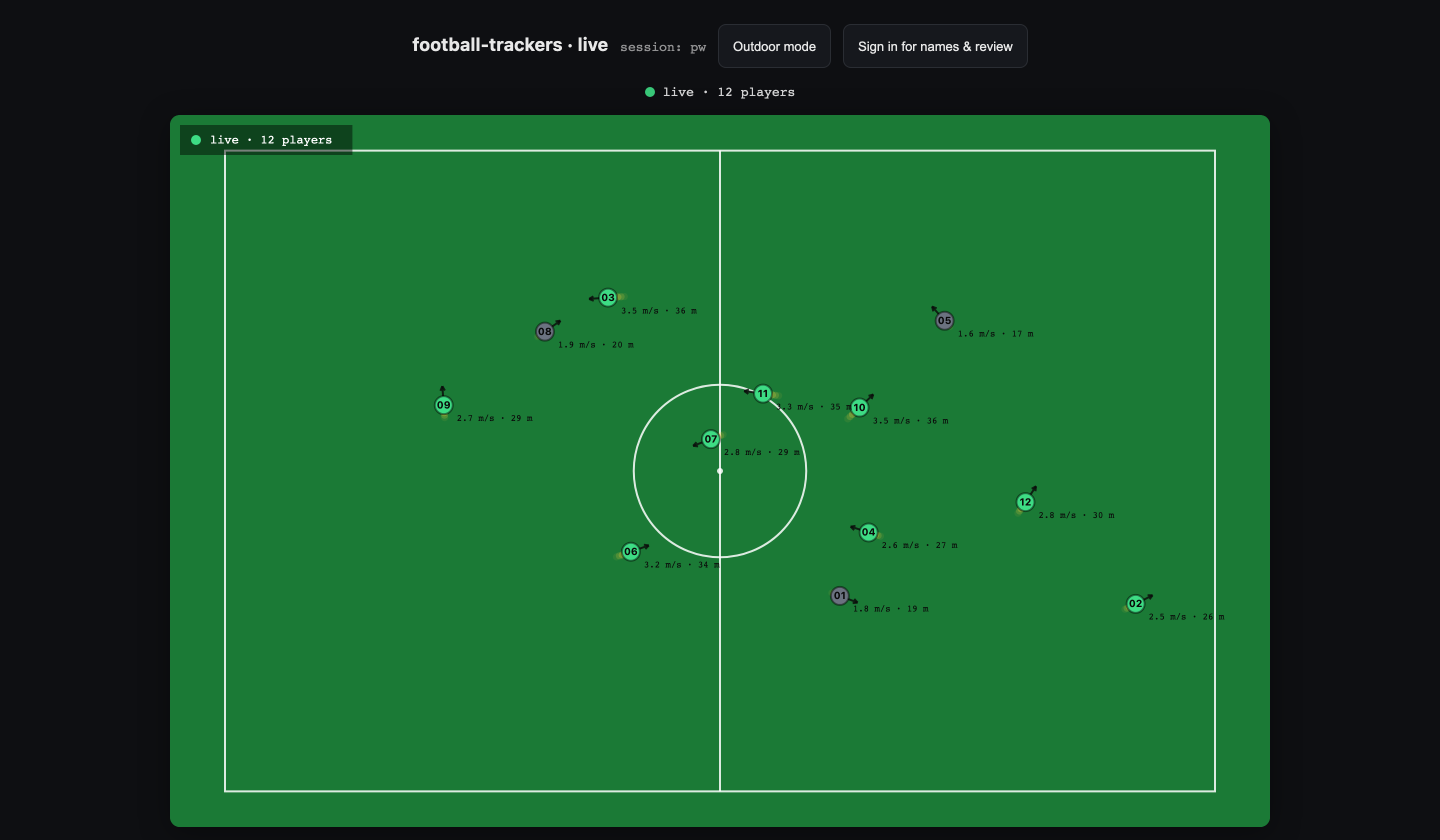 The coach live view rendering a 12-player simulated fleet at 10 Hz — captured from the hardware-free
e2e stack (
The coach live view rendering a 12-player simulated fleet at 10 Hz — captured from the hardware-free
e2e stack (bun run sim --standalone), which is also how every Playwright spec drives the real pipeline.
Architecture¶
flowchart LR
  subgraph pitch ["on-pitch (10x wearables)"]
    W["ESP32 + NEO-M8N<br/>10 Hz UBX-PVT<br/>LittleFS backlog on dropout"]
  end
  subgraph field ["field AP / laptop"]
    B["Mosquitto MQTT<br/>auth + per-device ACLs"]
    S["Bun + Elysia<br/>validate / serverTs / fan-out"]
    DB[("bun:sqlite<br/>WAL, 30-day retention")]
    M["Prometheus /metrics<br/>+ JSON logs"]
  end
  subgraph tablet ["coach tablet"]
    C["React live view<br/>canvas + GPS-to-pitch homography"]
  end
  W -- "WiFi, MQTT QoS0" --> B --> S
  S --> DB
  S -- "WS /live" --> C
  S -.-> M
MQTT topics:
- football-trackers/session/{sessionId}/player/{playerId}/telemetry — {id, pl, ts, lat, lon, spd, hdg, fix, sats, pdop}
- football-trackers/session/{sessionId}/player/{playerId}/status — device health (battery, RSSI, heap, backlog, fix), ~every 5 s
(ts = device millis, ordering only; serverTs is the authoritative timestamp.)
The server exposes Prometheus metrics on /metrics — see observability.
Run it in 60 seconds (no hardware)¶
Two terminals; needs Bun and mosquitto on PATH (brew install mosquitto).
Open http://localhost:5173 — the screenshot above is exactly this: a spawned broker + the real
server + 10 virtual devices publishing the firmware's wire contract at 10 Hz. Fault injection,
load ramps, record/replay and a --secure auth mode are one flag away
(server/README.md).
How this is built¶
- Decision discipline — 25 cross-referenced ADRs (context, alternatives, consequences, amendment chains) plus a frozen pre-code contract per frontend phase.
- Test rigor — one gate per part: 32 sequential server suites (~64 s) behind a runner that refuses to start if a test file is neither a declared suite nor a declared non-suite (the gate cannot silently shrink); client typecheck + lint + unit + Playwright e2e across five self-contained stacks (real broker, real server, simulated fleet — no mocks); a 177-test CPU-only vision suite; host-compiled firmware logic tests. All five run in CI on every push.
- Privacy as mechanism, not policy — pseudonymous ids on the wire and in the store, real names in one access-controlled file joined at render time only; per-player erasure that also rewrites every backup and proves it by re-count; 30-day retention; static posture guards that fail CI if the dev or production stack drifts (loopback binds, non-root images, authenticated broker).
- Audited — a 2026-08 production-readiness audit drove 8 hardening phases (graceful shutdown, schema migrations, verified backups, supply-chain pins), each closed by execution-verified acceptance criteria.
- Validated on real hardware — the assembled ESP32+NEO-M8N prototype streamed device -> Wi-Fi -> authenticated broker -> server -> live view end to end (2026-06-17).
The working method behind those habits — the agent configuration, the maker ≠ checker review discipline, the PM ceremony that turns "done" into a machine-checkable claim — is published separately as claude-code-monorepo, a 13-chapter book on the setup this project was built with.
Why DIY¶
Commercial trackers are either cheap-but-closed (no real-time, no open data) or have an API but cost a subscription per player. Goal here: real-time + fully owned.
Docs¶
Read them online: https://miloscvetkovicdev.github.io/football-trackers/ — all 52 documents and 25 ADRs, searchable, with the subproject READMEs alongside them.
Product & business requirements live in docs/: vision,
market analysis, BRD,
functional / non-functional
requirements, metric definitions, architecture,
observability, hardware BOM,
and decision records.
Repo layout¶
football-trackers/
  firmware/            ESP32 firmware (PlatformIO / Arduino)
    platformio.ini
    src/main.cpp
  server/              Bun + Elysia ingest + live fan-out (standalone app)
    src/
      types.ts         wire contract (RawTelemetry/Telemetry) + topic regex
      db.ts            bun:sqlite persistence
      ingest.ts        MQTT subscribe -> validate -> enrich -> persist + fan-out
      server.ts        Elysia entry: /live WS + /health, wires ingest
    test/              self-contained, hardware-free e2e (spawns broker+server)
  client/              Bun + Vite + React coach live view
    src/
      homography.ts    4-corner GPS->pitch projective transform (+ unit tests)
      useLiveTelemetry.ts  /live WS -> useRef Map (no per-packet re-render)
      PitchCanvas.tsx  rAF canvas render: pitch + player dots
  vision/              offline camera/CV analysis — SEPARATE subproject, Python, Docker-only
    footballcv/        decode -> detect+track -> team split -> annotate (v1 works end to end)
    webui/             paste a public YouTube link -> annotated video, behind a privacy gate
    test/              177 CPU tests; no torch, no weights, no network
  deploy/production/   the real deployment stack (non-root image, no anonymous access)
Offline camera/CV analysis — vision/¶
A separate, self-contained subproject (ADR-0023,
vision/README.md) that analyses recorded football video: detect + track players,
split them into two anchored teams, write an annotated video. It shares nothing with the tracker at
runtime — different language, different container, no network at inference time.
It exists because Track B below needs sensing the GPS trackers do not have, and a camera is one of
the two candidate routes. v1 is wired and verified end to end on public adult footage; --ball/--radar
(v2) and --stats over video (v3) are not implemented and exit non-zero rather than pretending.
The privacy gate is the point, not a formality. This runs on PUBLIC adult/professional footage ONLY — never youth footage, in any phase, with or without a claim of parental consent. Pointing a camera at the children this project otherwise tracks is a separate gate needing a DPIA, verified consent and a documented lawful basis, deferred to a future ADR (ADR-0023 §2/§14). The gate is enforced server-side, every clip in
samples/carries a provenance row, and the whole thing is loopback-only with a 24 h retention sweep.
cd vision
docker compose run --rm test       # the test suite (CPU image; runs on the Mac too)
docker compose up webui            # http://127.0.0.1:8077 — paste a public YouTube link
Hardware (1 prototype, sourced in Serbia)¶
- MCU: WEMOS Lite ESP32 (LOLIN32 Lite) — onboard LiPo charging
- GNSS: GY-GPSV3 NEO-M8N (u-blox, up to 10 Hz)
- Battery: LP-503759CL Li-Po 3.7V 1350 mAh
- Jumper wires (F-F) + male 2.54 mm header strip
- Tools: micro-USB cable, soldering iron, multimeter (verify LiPo polarity!)
Firmware¶
PlatformIO: cd firmware && pio run -t upload && pio device monitor.
Secrets are NOT in source — the WiFi PSK and this device's MQTT username (= PLAYER_ID) / password live in
NVS, set once over serial on first boot via the enroll console
(ADR-0014), so the same image flashes to every device
and only NVS differs. Full build / enrollment / rotation / flash-encryption runbook:
firmware/README.md.
Wiring (Serial2): M8N TX -> GPIO16, M8N RX -> GPIO17, plus 3V3 + GND. First fix: outdoors, 30-60 s cold start.
Server¶
Bun + Elysia, standalone (no build step). The MQTT ingest runs alongside the Elysia HTTP/WS server
in one process and fans out over native WS pub/sub. Full detail — every env knob, the auth model,
the suite-by-suite test map, the data-lifecycle CLIs and the simulator's whole flag set — lives in
server/README.md.
cd server && bun install
bun start          # PORT=3000, MQTT_URL, DB_PATH env — see server/README.md
bun run test       # THE GATE: all 32 suites, sequential, ~64 s (test/run-all.ts)
/live upgrade; the
principal is authorised against the requested session server-side
(ADR-0015,
ADR-0008). Provision a coach:
bun run auth-user.ts add coach --role coach --sessions test.
Quick end-to-end test (no hardware) — start a broker + the server, then:
mosquitto_pub -t 'football-trackers/session/test/player/01/telemetry' \
  -m '{"id":"trk-01","pl":"01","ts":1,"lat":44.8297,"lon":20.4007,"spd":3.2,"hdg":90,"fix":3,"sats":11,"pdop":1.2}'
/live?sessionId=test and watch for {event:"telemetry"} frames — or skip
the broker entirely and run the simulator.
Simulate a device fleet (no hardware)¶
test/simulate.ts is a virtual fleet: N MQTT clients publishing the
exact firmware wire contract (10 Hz telemetry + 5 s status) with believable movement, plus
fault injection (bad fixes / out-of-range / id-mismatch / rate bursts / dropout -> backlog ->
replay), load ramps with per-stage p99 reports, deterministic --record/--replay, and a
--secure mode that provisions per-player broker ACLs + a real coach login. Turnkey:
bun run purge-player.ts <playerId> — erases
the live store and every backup, and proves it by re-count
(ADR-0010).
Client (coach live view)¶
Bun + Vite + React. Connects a plain WebSocket to /live?sessionId=..., keeps the
latest fix per player in a useRef Map, and renders dots on a <canvas> via
requestAnimationFrame. GPS->pitch is a homography from the 4 corner coords. Phase 1 hardening
(see docs/frontend/improvement-plan.md) adds a DPR-crisp,
~30fps-capped canvas; an honest bounded-interpolation motion model (ADR-0018:
snap across gaps, never extrapolate); explicit connection failure states (no silent infinite
reconnect); an accessible DOM mirror + ARIA live region; a strict CSP; and an outdoor high-contrast
mode + screen wake-lock.
cd client && bun install
bun run dev        # http://localhost:5173 ; same-origin via Vite proxy: VITE_PROXY_TARGET (default http://localhost:3000), VITE_DEFAULT_SESSION (default test)
bun run typecheck  # tsc --noEmit
bun run lint       # eslint (flat config, react-hooks)
bun test           # unit: homography + interpolation honesty + inbound-WS-frame validation
bun run e2e        # Playwright smoke + a11y + explicit-failure-state, driven by the simulator (first: bunx playwright install chromium)
bun run e2e:frame-budget   # 50-player frame-budget + DPR-crisp gate (verified separately)
src/config.ts. The app now opens with a login screen
(ADR-0015): sign in with a coach/admin account, then it
connects to /live same-origin so the session cookie rides the upgrade — Vite proxies /live, /auth, and
/sessions to VITE_PROXY_TARGET, so no VITE_LIVE_TOKEN/VITE_WS_URL (both removed) and no per-client WS URL.
Add this app's origin (http://localhost:5173) to the server's ALLOWED_ORIGINS, and in dev set the server's
AUTH_COOKIE_SECURE=false (reach it via http://localhost, a secure context). With the server running and a
coach signed in, a mosquitto_pub of the README packet renders a dot at pitch centre. The CSP is
connect-src 'self' (same-origin WS + fetch + HMR) — no host to configure.
Local dev with Docker Compose (+ bench-testing a real wearable)¶
One command brings up the device-facing backend (MQTT broker + ingest/WS server); the coach view (Vite) runs on the host. Full walkthrough + troubleshooting: docs/dev/local-bench-runbook.md (ADR-0021).
./server/mosquitto/dev-provision.sh 01   # ONCE: broker accounts + .env (ft.passwd is gitignored)
docker compose up -d                     # broker (1883, authenticated) + server (127.0.0.1:3007)
cd client && VITE_PROXY_TARGET=http://127.0.0.1:3007 bun run dev   # coach view -> http://localhost:5173
MQTT_HOST to it; the device and
the Mac must be on the same Wi-Fi (a wired dock Ethernet was found to be isolated from the Wi-Fi).
- The coach view runs on the host, not in the stack — Vite's /live WebSocket proxy doesn't relay the upgrade
from a container.
- The broker is authenticated — it mounts the same allow_anonymous false config + per-device ACLs the field
broker uses, so docker compose up fails loudly until dev-provision.sh has created the accounts, and every
bench run exercises the real auth path. Re-running provisioning rotates credentials; follow it with
docker compose up -d, because restart does not re-read .env.
- The server is published on 127.0.0.1 only. It runs in anon live mode (no login for the pitch view), and a
no-login feed of children's positions must not also be reachable from the Wi-Fi. That makes the coach view
this-machine-only; a pitch-side tablet is the Caddy + real-auth deployment, not this stack. Use
http://127.0.0.1:3007 (not localhost) as the proxy target — the bind is IPv4-only.
- Names and Review still need a real login here. /roster, /history and /events answer 403
login_required for the anonymous principal; the anon view shows pseudonymous ids and a "Sign in for names &
review" button. Provision a coach with
cd server && AUTH_ACCOUNTS_FILE=./auth-accounts.json bun run auth-user.ts add coach --role coach --sessions test.
Status / next¶
- [x] Hardware ordered (1-2 prototype sets)
- [x] Firmware skeleton (10 Hz -> MQTT, LittleFS backlog on dropout); hardened in audit Phase 4 (2026-08-24): non-blocking reconnect + jittered backoff + 8 KB GPS buffer (an outage no longer starves the drain), crash-safe paced replay (NVS cursor +
sqdedupe server-side), GPS-UTCgtsso replays keep their real timestamps, watchdog + reset-reason/boot-count/version in.../status, id validation at enrollment, NVSsession_id, backlog age purge +wipe— bench acceptance run pending (see the runbook §7) - [x] Bun/Elysia ingest + WS fan-out + bun:sqlite persist (e2e verified, no hardware)
- [x] Observability: Prometheus
/metrics, JSON logs, device.../statushealth topic (e2e verified) - [x] Security MSI: token-gated
/live(+ Origin/CSWSH check), per-device MQTT creds + topic ACLs, server-sideid_mismatchreject (e2e verified). Architecture-board reviewed — see target-architecture + ADRs 0006–0014 - [x] Data minimisation (ADR-0010): 30-day raw-fix auto-purge (batched) that also prunes roster sessions whose fixes are gone, per-player erasure CLI (indexed + batched delete,
secure_delete+ forced WALTRUNCATEcheckpoint, permissive roster rewrite, distinct exit codes), self-reporting retention metrics — the five ways erasure was broken are pinned bytest/erasure-audit.ts(audit 2026-08-03 §4.5, Phase 2b) - [x] React live view: 4-corner pitch homography, useRef Map + rAF canvas (browser-verified, no hardware)
- [x] FE Phase 1 (client-only MSI): DPR-crisp/~30fps-capped canvas, honest bounded interpolation (ADR-0018), explicit failure states, accessible mirror + ARIA, strict CSP (
connect-srcwas derived from a bundled WS URL then; Phase 2 replaced it with'self'over the same-origin proxy), outdoor mode + wake-lock — typecheck/lint/unit + Playwright e2e through the simulator (p95 9.4 ms @ 50 players, DPR-crisp verified). See improvement-plan - [x] FE Phase 2 (auth & security core): named login (argon2id + HttpOnly cookie) -> cookie-on-upgrade; bundled
LIVE_TOKENkilled; principal-bound session authz on/live(ft_ws_rejected{reason="not_authorized_for_session"}); accounts file +auth-user.tsCLI; Vite same-origin proxy +connect-src 'self'; strict Origin; isolated-LAN anon scoped toANON_SESSIONS(ADR-0015, implements ADR-0008) — verified by the server auth e2e + client Playwright auth specs through the simulator - [x] FE Phase 3 (identity, health, review): per-session roster names via authenticated
GET /sessions/:id/roster(roster-user.tsCLI +roster.json, render-only client join, erasure-coupled inpurge-player) (ADR-0016); per-player device health as a second/liveenvelope ({event:'status'}) from the.../statustopic; review/replay via off-loop/pagedGET /sessions/:id/history(aggregate + heatmap default, raw scrub on demand) (ADR-0017) — names never reach the store/DB/metrics/logs/client-persistence; verified by the Phase-3 server tests + Playwright live/review specs. See improvement-plan - [x] Tactical event detection — Track A (ADR-0020, contract): off-loop
GET /sessions/:id/events— a bucketed team-shape series (centroid/compactness/hull) + heuristic high-tempo / transition / stoppage phases, rendered as a review-mode timeline; team-aggregate (no name/playerId, ever), honesty-labelled (confidence + provenance), the inflight cap shared with/history. Movement-derived, not confirmed ball events. Built frozen-contract → 5-lens pre-mortem (6 must-fix folded) → parallel slices → post-build review; verified bytest/events.ts+test/events-e2e.ts(270k-row off-loop SLO + shared-cap 503) + the Playwright review spec - [x] Validate full pipeline on ONE device (2026-06-17): real ESP32+NEO-M8N assembled → flashed → enrolled → device → Wi-Fi → broker → server → live view all confirmed end-to-end (server received the device's
.../statushealth + 10 Hz telemetry; indoors all positions correctly droppedno_fix, a syntheticfix=3packet rendered a dot). Local Docker stack + the bench runbook: docs/dev/local-bench-runbook.md. Remaining: the outdoor real-GPS dot + the LiPo battery (untethered field use) - [x] Coach-view reliability (audit Phase 5, 2026-08-26): server-clock skew correction (
serverClock.ts— a match-day LAN has no NTP, and a 10 s-fast tablet used to render an EMPTY pitch over a healthy feed); a recoverable reconnect give-up ("Reconnect now" + anonlinelistener, so a dead feed is no longer dead for the match); the pitch's four GPS corners moved out of the bundle into per-session config (session-config.ts set-pitch, validated on both sides so a degenerate quad can't white-screen the view); scoped error boundaries (a Review crash no longer takes the whole page); a deadline on every fetch + retries that actually re-fetch; off-pitch players pinned to the canvas edge instead of silently clipped; 44 px touch targets; and a minimal client beacon (ft_client_events_total{kind}) so a dark tablet is finally visible from/metrics. Verified by the new client unit suites + the Playwrightreliabilityproject (a real server kill/restart, a 30 s-skewed browser clock, an induced Review crash) +test/beacon-e2e.ts - [x] Operability (audit Phase 6, 2026-08-27, ADR-0025):
docker stopwent from exit 137 (SIGKILL) in 1.3 s to exit 0 in ~0.2 s — an ordered teardown (drain → abort scans → broker → listeners → hand over sessions → checkpoint) on a process that can finally receive the signal (exec+init: true), with a hard deadline so a wedged step cannot hand the kill back to Docker;uncaughtExceptionexits 1 through the same path,unhandledRejectionis counted and does not; aPRAGMA user_versionmigration ladder that refuses to start against a store newer than the build; verifiedVACUUM INTObackups whose rotation is bounded by bothBACKUP_KEEPandRETENTION_DAYS— and whichpurge-player.tsnow erases from, per file, with a proof-by-recount (a backup is a complete copy of children's location); a compose healthcheck on/health(broker down → unhealthy in 45 s, back in 10) plus capped logs; server-side scan cancellation (request.signal+ a 25 s budget — the item Phase 5 deferred);mode: 0o600that is no longer a no-op on an existing file; WS fan-out drops counted as drops rather than sends; coaches staying logged in across a restart (a 0600 file ofsha256(token)verifiers, consumed on read); and a real production stack —deploy/production/, non-root image with no roster/accounts/store in any layer, no anonymous access, nothing on0.0.0.0, guarded by 37 static checks intest/deploy-posture.ts. TLS for the field box is the one piece deliberately left open (it needs an internal-CA decision, not a guessed Caddyfile) - [ ] Persistence at scale: TimescaleDB hypertable (sqlite is fine for now)
- [ ] Football events — Track B (passes/shots/tackles): not derivable from GPS one-team positions — needs a calf IMU @200-500 Hz + ML, or one elevated 4K camera + CV. Scoped but deferred in ADR-0020 §6. The camera route is part-built:
vision/(ADR-0023) detects + tracks players and splits teams on public adult footage today (v1, verified end to end 2026-06-20; v2 ball/radar and v3 analytics-over-video are not implemented and refuse rather than no-op). What blocks it for THIS project is unchanged and is not an engineering problem: pointing it at the children needs the DPIA / consent / lawful-basis gate ADR-0023 §14 defers
Contributing & security¶
A personal project — issues are welcome, PRs by prior discussion, and anything exploitable goes through SECURITY.md (private reporting, please). Licensed MIT.